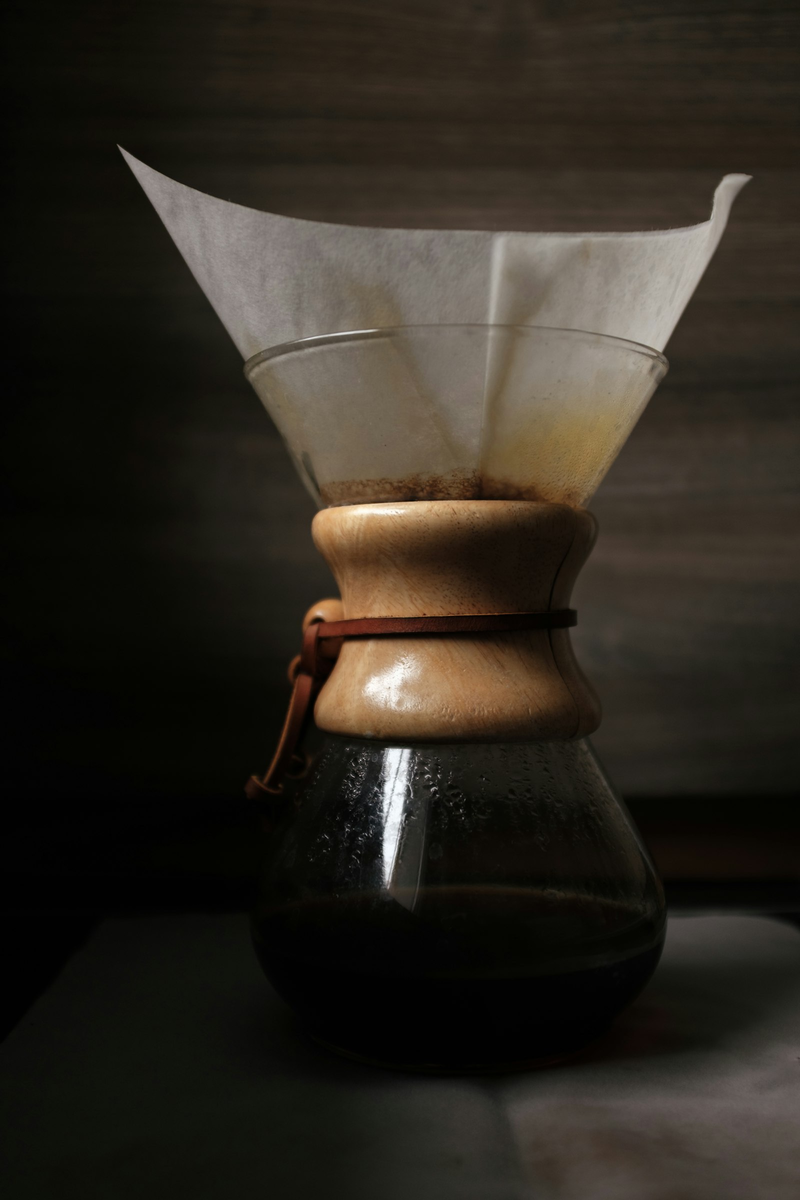
The Chemex was designed by a chemist in 1941 and looks nearly unchanged today. Its filters are bonded paper that traps not just sediment but most of the oils that give a French press its weight. The result is a cup that reads almost like a tea — bright, articulated, structurally honest.
What it is good at
Larger batches without losing precision. The Chemex is the only pour-over device we trust to brew for three or four people at once and still produce something worth drinking. It is also our preferred vessel for cold brew finished hot — a technique we will write about in a later volume.
Where it punishes
Cheap filters and tap water. The thick paper Chemex filter is half of what makes the device work; substituting another paper produces a thinner, less articulated cup. Hard tap water masks the brightness this brewer is built to emphasise.
The continuous-pour method
- Rinse the filter thoroughly with hot water. Discard the water.
- Bloom — 0:00 to 0:45. Add 70 g of water in a slow spiral. Wait.
- Main pour — 0:45 to 3:30. Maintain a steady stream, keeping the water level just above the bed. Do not pulse.
- Drawdown — 3:30 to 5:00. Let the bed fully drain. Do not stir.
The Chemex rewards patience and punishes interference. Pour, then leave it alone.
Storage and care
A finished Chemex carafe is a beautiful object. It is also a fragile one. Hand-wash with soap and warm water; never the dishwasher. The wood collar is removable for cleaning, held only by the leather thong. Replace the thong when it starts to stretch — the original was rawhide for a reason.